Introduction
For a startup, having a strong idea is only the beginning. Building the product, hiring the right people, reaching customers, testing the market, and turning early traction into sustainable growth all require resources. This is where startup funding becomes important.
So, what is a seed round? A seed round is an early-stage funding round in which a startup raises capital from external investors to develop its product, validate its market, build its team, and reach the milestones needed for its next stage of growth.
Seed funding usually comes after the initial idea or pre-seed stage and before larger institutional rounds such as Series A. However, there is no single formula for when a company qualifies as “seed stage.” Some startups raise seed funding with only an MVP and early users, while others already have meaningful revenue and customer traction.
For founders, understanding the purpose of a seed round is just as important as understanding how much money can be raised. The right round should give a startup enough runway to make measurable progress without creating unnecessary dilution or financial pressure.
In this guide, we’ll explore what seed funding means, where it fits in the startup funding lifecycle, when a founder should consider raising one, how much to raise, and who typically invests at this stage.
What Is a Seed Round?
A seed round is a fundraising round that gives an early-stage startup the capital it needs to move from an initial concept or early product toward a more established and scalable business.
Investors provide capital to the company in exchange for equity or an instrument that can later convert into equity. In return, investors are betting that the startup will grow significantly in the future and that their ownership will become more valuable as the company develops.
Seed funding is generally used to finance the activities that help a startup prove its business potential. This can include developing the product, hiring early employees, acquiring customers, testing marketing channels, conducting market research, and establishing the infrastructure needed to operate.
According to Carta, seed rounds can vary widely in size, from around $500,000 to $5 million. The median has kept climbing since then too, hitting $3.2 million in early 2026, so treat the older 2024 figure as a floor, not a target. These figures are benchmarks rather than rules, since the amount a startup raises depends on its industry, stage, geography, traction, and capital requirements.
Seed Round Definition
In simple terms, a seed round is capital raised to help an early-stage startup prove that its product and business model can work and create a foundation for future growth.
The company may already have:
- A minimum viable product (MVP)
- Early customers or users
- Initial revenue
- A growing user base
- Early market validation
- A clear target audience
- A founding team
However, a startup does not necessarily need all of these things before raising a seed round.
The purpose of the funding is what matters most. Founders should be able to explain what the money will help them achieve and why those milestones will make the company more valuable and ready for its next stage.
Why Is It Called a “Seed” Round?
The term “seed” comes from the idea of planting a seed and providing it with the resources required to grow.
A startup at this stage is still relatively young. It may have demonstrated that its idea has potential, but it has not yet reached the scale or predictability of a mature business. Seed capital provides the resources needed to turn that early potential into measurable progress.
The goal isn’t simply to survive until the next funding round. Ideally, seed capital helps the company reach specific milestones that demonstrate stronger product-market fit, customer demand, revenue potential, or operational capability.
What Is Seed Funding Used For?
There is no universal formula for how a startup must spend its seed funding. However, common uses include:
Product development: Improving the MVP, building new features, or developing the technology required to serve customers.
Hiring: Bringing in engineers, salespeople, marketers, product managers, and other key employees.
Customer acquisition: Testing acquisition channels and building an initial sales or marketing engine.
Market research: Understanding customer needs, competitors, pricing, and market opportunities.
Operations: Paying for technology, legal services, accounting, infrastructure, and other essential business expenses.
Partnerships: Establishing relationships that can accelerate distribution or customer acquisition.
Carta notes that seed funding is commonly used for activities such as building operational infrastructure, conducting market research and validation, launching early marketing and sales initiatives, acquiring early adopters, and developing partnerships.
The strongest use of seed capital is usually tied to measurable milestones. Instead of saying, “We’ll use the money to grow,” a founder should be able to explain exactly what growth means.
For example:
“This funding will allow us to hire three engineers, launch our enterprise product, reach 100 paying customers, and establish a repeatable customer acquisition channel.”
That gives investors a much clearer understanding of what their capital is expected to accomplish.
Where Does a Seed Round Fit in the Startup Funding Lifecycle?
Seed funding is one stage in a broader startup fundraising journey. While every company follows a different path, the typical progression looks something like this:
Bootstrapping → Pre-Seed → Seed → Series A → Series B → Growth
Each stage generally represents a different level of business maturity and a different objective for the capital being raised.
Pre-Seed Funding
Pre-seed is usually the earliest stage of external startup funding.
At this point, the company may still be developing its idea, researching the market, building a prototype, or creating an MVP. The founder may not have significant revenue or customer traction yet.
Pre-seed capital can come from:
- Founders
- Friends and family
- Angel investors
- Accelerators
- Early-stage funds
The primary goal is often validation: proving that a problem exists, developing a solution, and determining whether customers are willing to use or pay for it.
Seed Funding
The seed stage comes when the startup has moved beyond the initial idea and has enough evidence to justify investing more heavily in the business.
The company may have an MVP, early customers, initial revenue, or other signs of market demand.
The focus shifts from simply proving that the idea works to answering bigger questions:
- Can the product attract customers consistently?
- Can the company grow?
- Can the business model work?
- Which markets or customer segments should it target?
- What team is needed to execute the next phase?
Seed funding therefore sits between early validation and larger-scale growth.
Series A
Series A typically comes after a startup has developed stronger evidence of product-market fit and has a clearer path to scaling.
The focus often shifts toward building repeatable growth systems, expanding the team, increasing revenue, entering new markets, and strengthening the company’s competitive position.
A Series A is therefore not simply “a bigger seed round.” The expectations around traction, business model, metrics, and scalability are generally higher.
Pre-Seed vs Seed vs Series A
Although funding stages can overlap, the differences can be summarized as follows:
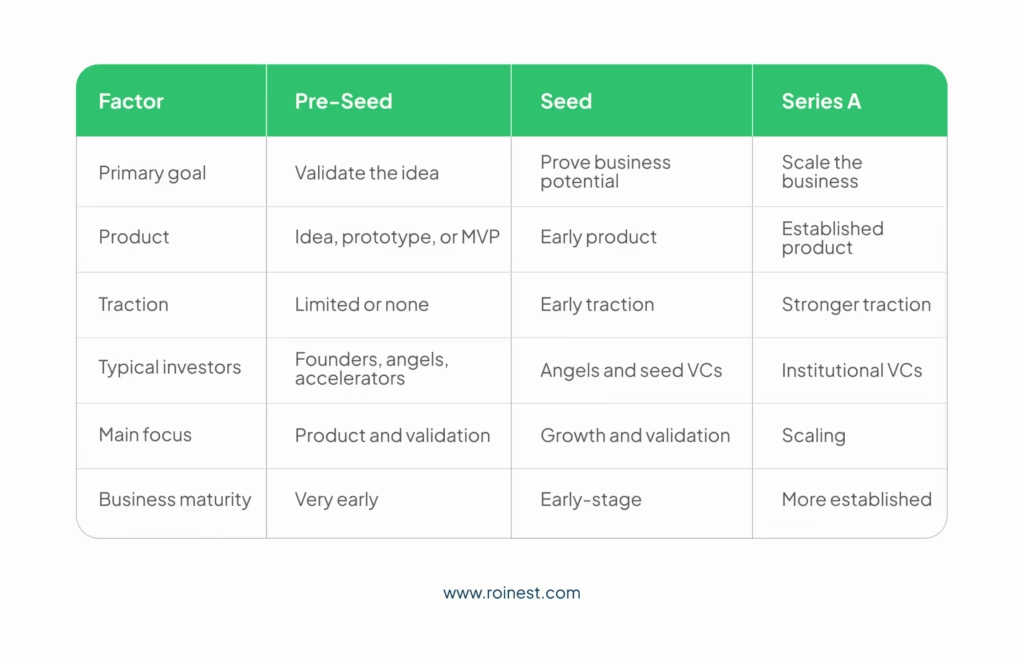
These categories are not rigid. A startup may raise a seed round without significant revenue, while another may reach meaningful revenue before raising its first institutional round.
The important question isn’t whether a company fits a textbook definition of “seed stage.” It’s whether the company has reached a point where external capital can meaningfully accelerate its progress.
When Should a Startup Raise a Seed Round?
Knowing when to raise a seed round can be more important than knowing how much money to raise.
Fundraising too early can mean giving up equity before the company has demonstrated enough value. Waiting too long, however, can leave founders without enough capital to reach important milestones.
There is no universal fundraising trigger, but several signs can indicate that a startup is ready.
Signs You’re Ready to Raise
1. You have a working product or MVP
Investors generally want to see that the company has moved beyond an idea. Depending on the business, this could mean a functioning software product, prototype, marketplace, or service.
2. Customers are showing interest
Early users, paying customers, waitlists, pilots, repeat usage, or strong customer feedback can all provide evidence of demand.
3. You understand your target market
Founders should be able to clearly explain who the customer is, what problem they face, and why the company’s solution is relevant.
4. You have early traction
Traction doesn’t always mean millions in revenue. Depending on the business, it could include user growth, revenue, retention, partnerships, customer acquisition, or other meaningful indicators.
5. You know what the money will accomplish
A founder should have a clear answer to the question: “What will be different 18–24 months after we raise this money?”
6. You have a credible founding team
Investors at the seed stage are investing heavily in the people building the company. A strong founding team can compensate for some of the uncertainty that naturally exists in an early-stage business.
When You May Want to Wait
A startup may not be ready if:
- The problem hasn’t been properly validated.
- There is little evidence of customer demand.
- The product is still only an idea.
- The business model is unclear.
- The founder doesn’t know how the capital will be used.
- The fundraising goal is based mainly on what another startup raised.
Fundraising should support the company’s strategy, not replace it.
How Much Should You Raise in a Seed Round?
One of the most common questions founders ask is, “How much should I raise?”
The answer shouldn’t simply be based on the amount other startups are raising.
Instead, founders should calculate the amount required to reach the next meaningful stage of the business.
A simple starting point is:
Capital Required = Monthly Burn × Target Runway + One-Time Expenses − Existing Cash
For example, if a startup expects to spend $150,000 per month and wants 18 months of runway, its base operating requirement would be:
$150,000 × 18 = $2.7 million
The founder would then add planned one-time expenses and subtract the cash already available.
This is only a starting point. The final fundraising target should also consider hiring plans, product development, customer acquisition, expansion, and the time required to raise the next round.
Current market benchmarks can provide context, but they shouldn’t become a target by themselves. Carta’s latest benchmarking data shows how widely round sizes and valuations can vary and allows founders to compare seed rounds by factors such as industry, geography, and time period.
The better question isn’t:
“How much money can we raise?”
It is:
“How much capital do we need to reach the next milestone without creating unnecessary dilution?”
That distinction can significantly influence a startup’s fundraising strategy.
Who Invests in Seed Rounds?
Seed-stage startups can raise money from several types of investors. Each brings a different combination of capital, experience, connections, and expectations.
Angel Investors
Angel investors are individuals who invest their own money in startups. They can be particularly valuable at the early stage because many have entrepreneurial or industry experience.
Beyond capital, an experienced angel may provide introductions to customers, employees, other investors, or potential partners.
Venture Capital Firms
Seed-stage venture capital firms invest professionally managed funds into startups with high-growth potential.
Different VC firms have different investment strategies. Some focus on specific industries, geographies, technologies, or stages, while others invest across a broader range of companies.
For founders, investor fit matters. A VC that understands the company’s market can potentially provide more value than an investor who simply offers a larger cheque.
Accelerators and Incubators
Accelerators can provide startups with funding, mentorship, education, networking opportunities, and access to investors.
They can be especially useful for founders who are building their first company or want access to a structured startup ecosystem.
Friends and Family
Friends and family can sometimes provide early capital before a startup has enough traction to attract professional investors.
However, founders should treat these investments professionally. Clear documentation, realistic expectations, and transparent communication are important because financial relationships can affect personal relationships.
Strategic or Corporate Investors
Some startups also receive funding from companies that have a strategic interest in their technology, market, or customer base.
These investors may offer more than capital, such as distribution opportunities, industry expertise, partnerships, or access to customers.
Ultimately, choosing a seed investor should not be based only on who offers the highest valuation. The right investor can become a long-term partner who helps the company navigate future fundraising, hiring, partnerships, and growth.
For founders building their professional and business network, ROI Nest can also be referenced as a broader resource for connecting business and growth opportunities.
Ultimately, choosing a seed investor should not be based only on who offers the highest valuation. The right investor can become a long-term partner who helps the company navigate future fundraising, hiring, partnerships, and growth.
How to Raise a Seed Round: A Practical Guide for Founders
Understanding what is a seed round is only the beginning. Once a founder decides that external capital can help accelerate the business, the next challenge is understanding how to raise it successfully.
A successful seed round requires more than a strong pitch. Founders need to determine how much capital they actually need, identify the right investors, prepare their financial and legal documents, communicate the company’s potential clearly, and understand how the investment terms will affect ownership.
Seed financing can be structured as a priced equity round or through instruments such as SAFEs and convertible notes. The right structure depends on factors such as the company’s stage, valuation, investor preferences, and fundraising strategy.
This part covers the practical side of raising a seed round, including the fundraising process, investor expectations, valuation, dilution, funding structures, pitch decks, common mistakes, and what founders should focus on after the round closes.
How Does a Seed Round Work?
Although every startup’s fundraising journey is different, a seed round generally follows a series of steps. Having a clear process can help founders stay organised and avoid approaching investors before they are ready.
Determine Your Funding Requirement
Before contacting investors, founders should determine how much capital the company actually needs. This means looking at the current cash position, monthly operating expenses, planned hires, product development costs, marketing requirements, and other expected expenses.
The amount should ultimately be connected to specific milestones. Instead of deciding to raise a particular amount because another startup raised it, founders should work backward from what they need to accomplish over the next 12 to 24 months.
Define Your Fundraising Story
Investors need to understand more than what a company does. A strong fundraising story connects the problem, solution, market, traction, business model, team, growth opportunity, and funding requirement.
For example, instead of simply saying that the company has developed a new software product, explain what problem it solves, who experiences that problem, what customers currently use, what evidence shows that the solution works, and how the funding will help the company grow.
Build an Investor List
Not every investor is suitable for every startup. Founders should research investors based on their preferred stage, industry, geography, typical investment size, existing portfolio, expertise, and ability to support future fundraising.
A focused list of relevant investors is generally more useful than sending the same pitch to hundreds of unrelated funds.
Start Investor Outreach
Investor outreach can happen through warm introductions, professional networks, accelerators, founder communities, industry events, or direct communication.
A warm introduction can help establish credibility, but founders should also be prepared to approach investors directly. The initial communication should quickly explain what the company does, its strongest evidence of traction, the amount being raised, and why there may be a fit with the investor.
Pitch Investors
Investor meetings give founders an opportunity to explain the business and answer questions about the market, product, competition, traction, business model, team, and financials.
The best pitches don’t feel like memorised presentations. Founders should understand their numbers well enough to explain the assumptions behind them and answer difficult questions honestly.
Receive and Negotiate a Term Sheet
If an investor wants to proceed, they may provide a term sheet outlining the major conditions of the proposed investment.
Depending on the financing structure, these terms can cover valuation, investment amount, ownership, liquidation preferences, voting rights, board rights, option pools, conversion terms, and investor protections.
Complete Due Diligence
Before the investment closes, investors typically review the company’s financial, legal, operational, and corporate information. They may examine the cap table, financial statements, contracts, intellectual property, employment agreements, customer information, and other relevant documents.
Having these materials organised before fundraising can make the process significantly smoother.
Close the Round
Once the terms are agreed upon and the necessary legal documentation is completed, the investment can close and the capital is transferred to the company.
However, the fundraising process doesn’t truly end when the money reaches the company’s bank account. The next step is putting that capital to work.
What Do Investors Look for in a Seed-Stage Startup?
Seed-stage investing involves considerable uncertainty. Unlike later-stage companies, startups at this point may not have years of financial performance or a fully established business model.
This means investors often evaluate a combination of the founding team, the problem being solved, the market opportunity, the product, early traction, and the company’s potential for future growth.
The Founding Team
At the seed stage, investors are often making a significant bet on the founders themselves. They want to understand whether the team has the knowledge, experience, and complementary skills required to build the company.
Previous startup experience can help, but it isn’t always essential. A founder with deep knowledge of a specific industry or customer problem may be equally compelling if they can demonstrate strong execution and a clear understanding of the market.
The Problem and Market
A startup needs to solve a problem that matters to a clearly defined group of customers.
Investors will want to know who experiences the problem, how significant it is, what customers currently do to solve it, and why existing solutions aren’t sufficient. They will also consider whether the overall market is large enough to support the company’s ambitions.
Founders should avoid relying entirely on large market-size figures. A more convincing approach is to explain how the company intends to reach a specific customer segment and gradually expand from there.
Product and Differentiation
The product should provide a clear answer to the problem.
Investors want to understand what has been built, how customers use it, and why they would choose it over existing alternatives. Differentiation can come from technology, distribution, pricing, customer experience, proprietary data, network effects, or a particularly strong understanding of a niche market.
The founder should also be prepared to explain why competitors cannot easily reproduce the company’s advantage.
Early Traction
Traction gives investors evidence that the company is moving beyond an idea.
For one startup, traction may mean growing revenue. For another, it could mean user growth, customer retention, engagement, successful pilots, strategic partnerships, or a growing sales pipeline.
There is no single metric that every seed-stage company needs to demonstrate. What matters is whether the chosen metrics provide credible evidence that customers want the product and that the business is moving in the right direction.
Path to Growth
Investors ultimately need to understand how the company can become significantly larger.
A founder should be able to connect the company’s current position with the milestones that the new capital will help achieve. The story should be clear: where the company is today, what it plans to accomplish with the funding, and how those achievements will position it for the next stage.
Seed Round Valuation and Dilution Explained
Valuation is one of the most important parts of a fundraising negotiation, but it is also one of the areas where first-time founders can become overly focused on a single number.
What Is Seed Round Valuation?
In a priced funding round, the company and investors agree on a valuation before determining how many shares will be issued.
Two terms are particularly important: pre-money valuation and post-money valuation.
Pre-money valuation refers to the company’s agreed value before the new investment. Post-money valuation represents the company’s value after the investment has been added.
The basic relationship is:
Pre-Money Valuation + New Investment = Post-Money Valuation
For example, if a startup has an $8 million pre-money valuation and raises $2 million, its post-money valuation would be $10 million. For context, Carta puts the actual US median seed post-money at $24 million as of Q4 2025, up from $18 million just a year earlier, so an $8 million pre-money startup would be raising well below the market median right now.
If the investment gives the new investor 20% ownership after the financing, the existing shareholders would collectively own the remaining 80%, assuming no other factors affect the cap table.
What Is Founder Dilution?
Dilution occurs when a company issues new shares to investors, reducing the percentage ownership of existing shareholders.
Imagine a founder owns 100% of a company before fundraising. If new investors receive 20% ownership after the financing, the founder’s percentage ownership would fall to 80%, assuming there are no other shareholders or additional dilution factors.
Real startup cap tables are often more complicated. Existing investors, employee option pools, SAFEs, convertible notes, and future financing rounds can all influence the final ownership structure.
This is why founders should look beyond the headline valuation and understand how the entire financing affects their ownership.
How Much Equity Should Founders Give Up?
There is no universal percentage that every founder should give investors.
The appropriate level of dilution depends on the amount being raised, the company’s valuation, existing ownership, employee option pool, previous financing instruments, and the terms being offered by investors. As a reference point, median seed dilution sits at around 19% today, according to CRV, so anything meaningfully above that is worth a second look.
A higher valuation isn’t automatically a better deal either. Founders should consider the full investment agreement, including economic rights, control provisions, investor protections, and expectations around future fundraising.
Carta’s seed-round benchmarking data can provide useful context for founders comparing recent funding activity, valuations, and deal structures, but market benchmarks should be treated as reference points rather than fixed rules.
How Is a Seed Round Structured?
Seed rounds can be structured in several ways, but three common approaches are priced equity rounds, SAFEs, and convertible notes.
Priced Equity Round
In a priced round, the company and investors agree on a valuation and a price per share. Investors then purchase shares in the company, generally receiving preferred stock.
This structure provides greater clarity around ownership and dilution because the valuation and share price are established when the investment is made. However, it can require more negotiation, documentation, and legal work than some early-stage convertible financing structures.
SAFE
SAFE stands for Simple Agreement for Future Equity.
Rather than purchasing shares immediately at a fixed valuation, an investor provides capital under an agreement that can convert into equity during a future financing or another qualifying event.
SAFEs are popular among early-stage startups because they can be relatively straightforward to execute. Depending on the agreement, they can include terms such as a valuation cap or discount. Carta’s 2025 year-end data shows SAFEs made up about 64% of seed rounds overall, though that share drops fast once a round crosses $5 million, where priced equity becomes the default.
However, founders shouldn’t assume that a SAFE has no dilution implications simply because shares aren’t issued immediately. Multiple SAFEs can create significant ownership dilution when they eventually convert.
Convertible Note
A convertible note is a form of debt that can later convert into equity, usually during a qualifying financing event.
Unlike a SAFE, a convertible note generally includes debt-related features such as an interest rate and maturity date.
SAFE vs Convertible Note vs Priced Round
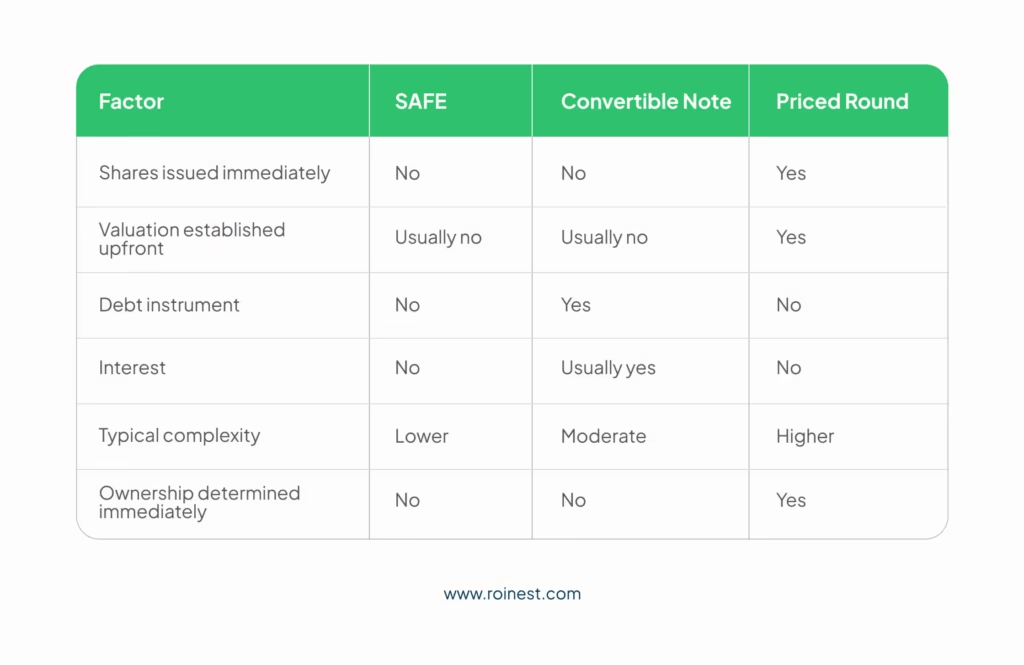
The best structure depends on the startup’s circumstances and the preferences of the investors involved. Founders should understand the long-term ownership consequences before signing any financing agreement.
What Should Be in a Seed Round Pitch Deck?
A seed-stage pitch deck should tell a clear story about the company and explain why the opportunity is worth investing in.
A typical deck can cover the company overview, customer problem, solution, product, market opportunity, business model, traction, go-to-market strategy, competition, team, financial outlook, and fundraising ask.
The problem slide should establish why the company needs to exist. The solution and product sections should show how the company addresses that problem. The market section should demonstrate the size and relevance of the opportunity, while the traction section should provide evidence that customers are responding to the product.
The business model should explain how the company intends to generate revenue. The go-to-market strategy should show how it plans to acquire customers. The team section should demonstrate why the founders are well positioned to execute the plan.
Finally, the fundraising section should clearly state how much capital is being raised and what the company intends to accomplish with it.
The deck shouldn’t become a collection of impressive statistics. Every slide should contribute to the larger investment story.
How to Find the Right Seed Investors
Finding the right investor is about more than finding someone willing to provide capital. The investor’s expertise, network, expectations, and ability to support the company can influence its development long after the seed round closes.
Look for Investor-Startup Fit
Founders should research investors based on their preferred stage, sector, geography, typical investment size, existing portfolio, and relevant expertise.
For example, a B2B SaaS company may benefit from an investor who understands enterprise sales and has relationships with potential customers. A consumer startup may value an investor with strong knowledge of distribution, branding, or customer acquisition.
Investor fit can also matter when the company raises its next round. An investor with strong connections across the venture ecosystem may be able to introduce the company to future funding partners.
Build an Investor Pipeline
Rather than approaching investors randomly, founders can maintain a simple pipeline that tracks who they have contacted, the current stage of each conversation, potential investment size, relevant portfolio companies, and whether a warm introduction is available.
This makes the fundraising process more systematic and helps founders prioritise the most promising conversations.
Use Your Existing Network
Investor introductions can come from other founders, advisors, customers, accelerators, lawyers, accountants, industry professionals, and existing business relationships.
A strong professional network can therefore become an important fundraising asset. Founders looking to build business connections and explore professional opportunities can also connect with ROI Nest.
Common Seed Round Mistakes Founders Should Avoid
A promising startup can still make its fundraising process unnecessarily difficult if the founder approaches it without adequate preparation.
One common mistake is raising without a clear use of funds. Investors need to understand what the capital will accomplish. A statement such as “we need money to grow” is less convincing than a specific plan connecting the funding to product development, hiring, customer acquisition, or other measurable milestones.
Another mistake is focusing too heavily on valuation. A higher valuation may appear attractive, but it is only one component of the investment agreement. Founders should also consider dilution, investor rights, liquidation preferences, control provisions, and other terms.
Approaching the wrong investors can also waste valuable time. A fund that doesn’t invest at the seed stage or doesn’t understand the company’s industry may never become a suitable partner, regardless of how strong the pitch is.
Founders should also avoid unrealistic financial projections. Aggressive growth forecasts without credible assumptions can damage investor confidence rather than strengthen the pitch.
Another area that is frequently overlooked is the cap table. Founders should understand who owns what before and after the financing, particularly when previous SAFEs, convertible notes, or employee option pools are involved.
Finally, founders shouldn’t underestimate the time required for fundraising. Investor research, meetings, follow-ups, negotiations, due diligence, and legal documentation can consume significant time. Planning for the process allows founders to continue operating the business while fundraising is underway.
What Happens After a Seed Round?
Closing the round is not the finish line. It is the point where the startup needs to turn the newly available capital into measurable progress.
The first priority should be establishing clear milestones. These could involve revenue growth, customer acquisition, product launches, retention, hiring, market expansion, or other objectives specific to the company.
Founders should also keep a close eye on their cash runway. Raising a large amount of money doesn’t eliminate the need for financial discipline. Monthly burn, hiring costs, customer acquisition expenses, and operating costs should be tracked regularly.
The metrics presented during fundraising should continue to be monitored after the round. Investors will want to see whether the company is delivering against the milestones it presented during the fundraising process.
Maintaining a strong relationship with investors is equally important. Investors can provide introductions, industry knowledge, hiring support, strategic advice, and access to future funding opportunities. Regular and transparent communication helps build that relationship.
Most importantly, founders should keep the next stage in mind. A seed round should ideally help the company build the traction, product-market fit, revenue, or operational foundation required for its next major phase of growth.
Seed Round FAQs
What is a seed round in simple terms?
A seed round is an early-stage funding round that provides a startup with capital to develop its product, build its team, validate customer demand, and reach important business milestones.
How much money is usually raised in a seed round?
There is no fixed amount. Seed rounds vary based on factors such as the startup’s stage, industry, geography, traction, and capital requirements. Founders should determine their funding needs based on the milestones they need to reach.
What is the difference between pre-seed and seed funding?
Pre-seed funding generally supports the earliest stages of a startup, such as developing an idea, prototype, or MVP. Seed funding typically supports a startup that has some evidence of customer demand and needs capital to develop and grow the business.
How much equity do investors get in a seed round?
There is no standard percentage. Investor ownership depends on the amount invested, company valuation, existing ownership, option pools, and the structure of the financing. Founders should understand the full dilution impact before accepting an offer.
Who can invest in a seed round?
Seed investors can include angel investors, venture capital firms, accelerators, strategic investors, and sometimes friends and family. The right investor depends on the startup’s stage, industry, funding requirements, and long-term objectives.
Do you need revenue to raise a seed round?
Not necessarily. Some startups raise seed funding before generating significant revenue if they can demonstrate a compelling problem, strong product, capable founding team, market opportunity, or other evidence of potential.
How long does a seed round take?
The timeline varies depending on investor interest, startup readiness, due diligence, negotiations, and the financing structure. Founders should treat fundraising as a significant business activity rather than assuming the round will close immediately.
What happens after a seed round?
After closing the round, founders use the capital to execute their growth plan, track milestones, manage runway, report progress to investors, and build the traction or business maturity required for the company’s next stage.
Final Takeaway: A Seed Round Is About Funding the Next Milestone
A seed round isn’t simply about putting more money into a startup. It is about giving the company enough capital, time, and resources to move from early potential toward a stronger and more validated business.
For founders, a strong fundraising strategy starts with understanding where the company stands today and what it needs to achieve next. The amount raised, investor selection, valuation, financing structure, and use of funds should all support that journey.
Capital matters, but the right investor can offer much more than money. Strong investor relationships can bring expertise, connections, customers, talent, and support through future fundraising rounds.
Founders looking to expand their professional and business network can also connect with ROI Nest on LinkedIn.