
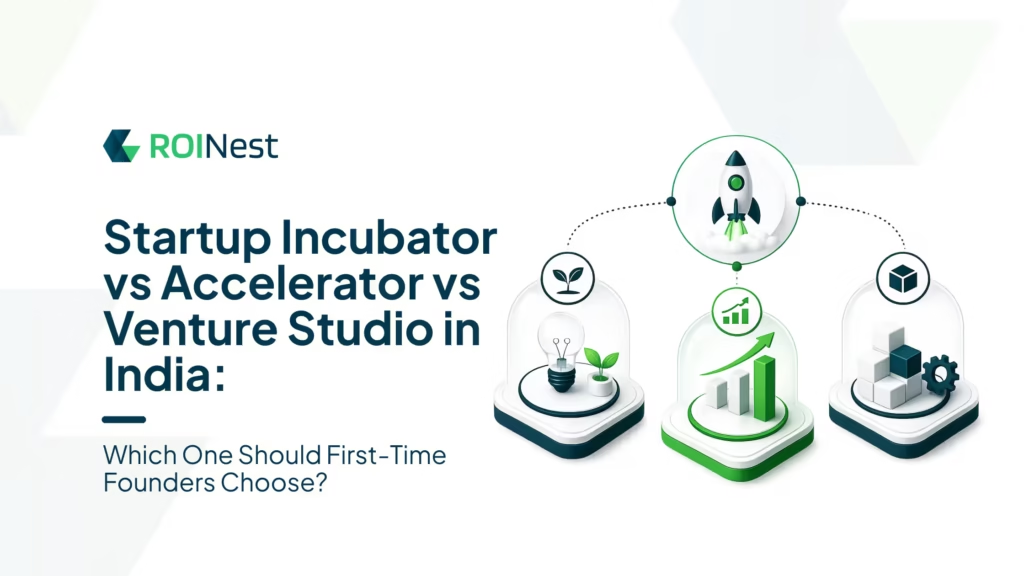
First-time founders begin with a half-clear idea, a few customer conversations, some notes in a spreadsheet, and a strong feeling that their chosen problem is worth solving.
Then the search starts. Should they join a startup incubator, apply to a startup accelerator, look for a venture studio, or perhaps speak to angels?
India has built a much stronger early-stage support system over the last few years. As of April 2026, the country had crossed 2.23 lakh recognised startups, and the Startup India Seed Fund Scheme had selected 219 incubators with more than ₹605 crore approved to over 3,400 startups.
So the support exists but the choice to be made is picking the right model that matches your specific bottleneck.
This ROINest guide will help you make a clear choice that is right for YOU, so read on!
What Is a Startup Incubator?
A startup incubator is built for founders who are still shaping the idea.
The founder does not have a finished product, a paid customer, or a clear market. A startup incubator gives founders room to test, refine, understand what they are building.
In India, incubators are often universities, government-backed institutions, research centres, industry bodies, or innovation hubs and their role is to help early founders move from intention to proof. Some offer workspace, some mentorship. Some might help out with grants, a basic business setup, investor readiness, access to networks, etc.
Incubators are crucial to the early-stage funding chain. The scheme supports work such as proof of concept, prototype development, product trials, market entry, and commercialisation through selected incubators.
For a first-time founder, the startup incubator can bring down their confusion.
A good startup incubator gives structure to a phase that is otherwise considered loose. Instead of randomly speaking to mentors founders get scheduled reviews, milestone checks, pitch feedback, legal guidance, etc.
A startup incubator may fit well when the founder is still working through questions like these.
- Does the problem appear often enough to build a company around it?
- Can the founder explain the user, buyer, and budget owner clearly?
- Is there a clear first market, or is the idea still too broad?
- Does the team need help turning research into a testable product direction?
- Is the startup still too early for venture capital, but too serious to remain a side project?
A startup incubator can help founders avoid building too much before learning enough. That matters in B2B. A founder can spend six months building a dashboard, only to learn later that buyers wanted workflow automation, audit trails, or integration support instead.
Many incubators are guidance-led. They may not sit inside the company’s product, sales, hiring, customer success, and go-to-market work every week. They can open doors, but the founder still has to walk through them. They can review the pitch, but they may not rewrite the pricing model, speak to design partners, or help close the first ten customers.
It is not always enough when the founder already knows the problem and now needs operators, execution rhythm, product depth, GTM support, and a builder network around the company.
What Is a Startup Accelerator?
A startup accelerator usually works through a fixed program window. Many programs run for a few months, bring founders into a selected batch, offer mentorship, push weekly progress, and end with investor exposure or a demo day. Some may offer funding in exchange for equity.
Accelerators are mentor-based programs that provide guidance, support, and limited funding, often in exchange for equity. Compared to a startup incubator, the flow is faster.
A startup incubator gives space to shape the idea. A startup accelerator puts pressure on the company to take action. The founder is expected to already know enough about the problem to work at speed.
For example, a B2B SaaS founder enters with a product used by ten early teams. The accelerator helps them clean-up their pitch, narrow down the ICP, fix pricings, speak to investors, and get better at selling the same product to a more serious buyer group.
But accelerators are not always designed for slow discovery. They work better when the company has something to accelerate. A half-formed idea struggles inside a program that expects weekly growth and investor updates.
Current accelerator programs also tend to be more stage-specific. For instance, one India-focused accelerator is a three-month equity-free program built for Seed to Series A funded AI-first startups headquartered in India. Another well-known global batch for Summer 2026 is scheduled from July to September in San Francisco, which also shows how fixed and time-bound these programs can be.
Some founders start optimizing for the program instead of the company. They polish the deck before the product is ready. They chase investor language before understanding the buyer. They prepare for demo day while the onboarding flow still confuses users.
A startup accelerator works best when the company has already crossed the early fog. The founder does not need ten more opinions on whether the idea is worth exploring. They need clearer sales motion, stronger metrics, better investor readiness, and access to people who can open the next set of doors.
A SaaS, AI, adtech, or B2B product may look ready from the outside because the deck is clean and the product has a few screens. Inside, the company may still have open questions around data workflows, implementation time, integrations, customer success, pricing, compliance, and sales ownership.
What Is a Venture Studio?
A venture studio is a more hands-on company-building model. Some people also know this model as a startup studio, venture builder, or company builder.
Many names but one job, it helps build the company from inside the operating room. The model is still being defined because different studios work in different ways.
A startup incubator helps founders validate an idea. A startup accelerator helps young companies take action more swiftly than before. Venture studios go deeper into the actual build.
The support can include product direction, tech architecture, hiring, sales motion, marketing systems, customer success thinking, legal setup, finance discipline, and access to operator networks. Some studios bring capital too, but it is only a part of it.
The venture studio model fits founders who need execution support around the company. They need someone to help convert a sharp idea into a working product, a believable GTM motion, and a business that can stand in front of customers and investors without sounding half-built.
That’s the reason more & more founders now search for venture studios in India while comparing early-stage support models. India has a large founder base, strong technical talent, growing SaaS depth, and increasing global ambition, but many new founders face gaps in product-market clarity, enterprise sales, pricing, onboarding, hiring, and fundraising readiness. Venture studios help close some of those gaps.
Still, it is important to remember that venture builders can add speed, structure, and people, but the founder still has to make decisions, speak to customers, handle rejection, and stay close to the product.
The trade-off is also different. A startup incubator takes little or no equity whereas on the other hand a startup accelerator takes a smaller equity stake for funding, mentorship, and access.
A venture studio may take a more meaningful equity position because it contributes operators, shared infrastructure, capital, and company-building work over a longer period.
That is not good or bad though. It depends on what the founder is getting in return.
How Does a Startup Incubator Differ From an Accelerator and Venture Studio?
A startup incubator is closer to the idea and validation stage.
It gives early founders a place to test the problem, shape the product direction, understand basic business setup, and access early support. In India, this model connects strongly with official startup support systems. For example, The Startup India Seed Fund Scheme provides assistance through selected incubators for proof of concept, prototype development, product trials, market entry, and commercialisation.
A startup accelerator is more time-bound.
It works with startups that already have some early proof and need better movement. Accelerator programs run for a fixed period, often around three months, and focus on mentorship, product input, leadership training, market access, and investor readiness.
A venture studio works closer to the build itself.
It helps create, validate, launch, and grow companies with shared teams, capital, operating systems, and deeper execution support. The model can be simply defined as company creation through shared infrastructure, capital, and hands-on support.
| Model | Best Fit | Support Style | Typical Stage | What to Expect |
| Startup incubator | Founders shaping an idea | Guidance, mentorship, early validation, grants, networks | Idea to prototype | Space to test and refine |
| Startup accelerator | Founders with early traction | Time-bound program, mentors, investor access, growth push | Prototype to early growth | Speed, pressure, and investor readiness |
| Venture studio | Founders who need build support | Operators, product help, GTM support, shared systems, capital | Idea to launch or early build | Deeper execution support |
A startup incubator can help a founder understand whether the problem they have chosen to solve is even worth solving or not. A startup accelerator helps grow a company that already has proof. A venture studio works with the founder on the actual company-building work, from product, hiring, GTM, to customer motion.
All three models can be useful, it’s just that they solve different problems.
Why Do First-Time Founders Need More Than Mentorship or Capital?
First-time founders have all heard the same set of advice early on.
Find a mentor. Raise some money. Build a network. Join a startup incubator. Apply to a startup accelerator. Keep speaking to investors…
India has made this support more visible in recent years. The Startup India Seed Fund Scheme supports proof of concept, prototype development, product trials, market entry, and commercialisation through selected incubators. The 2026 government update also says 219 incubators had been selected under the scheme, with more than ₹605 crore approved to over 3,400 startups.
But support on paper and progress inside the company are two different things.
The company needs concrete decisions, someone to look at the product roadmap and say which feature should wait, someone to check whether the sales pipeline has real buying intent or just fluff. These small operating calls shape the company much earlier than you’d expect.
A startup incubator can help the founder get early direction. A startup accelerator can bring pace, mentor access, and investor preparation.
These models are useful when the founder’s needs match the program, but when the founder needs operating depth and joins a model built mainly around guidance, sessions, and introductions, the team may not know how to turn feedback into a functioning product.
Take a SaaS founder building for mid-market teams, for example. The idea is strong, the first demo gathers interest too and a few prospects even said they would love to try it. But then who owns the budget? How long does implementation take? Will the product connect with the buyer’s existing tools? Can the team explain value in the first week? Is the pricing too low for enterprise buyers and too high for smaller teams?
These are strategy questions that are evident inside the daily build.
This is why the venture studio model has become more relevant for execution-focused founders since it works closer to the company-building process. A research published in 2025 describes venture studios as organizational co-founders that provide operational and strategic support from the beginning.
Instead of only advice, founders gain access to people who help shape product, technology, GTM, hiring, customer success, finance, and market access.
The choice should come from the company’s actual gap.
Some founders need the space and structure of a startup incubator. Some need the speed of a startup accelerator. Some need a venture builder because the company is ready to move, but the founding team still needs stronger execution muscle across product, sales, marketing, tech, and customer success.
Follow us on LinkedIn for weekly updates and bite-sized informational content.
Frequently Asked Questions
1. When should a founder apply to a startup incubator?
A founder should consider a startup incubator when the business idea still needs validation, early product direction, mentor input, and access to structured support. It is usually a better fit before the company starts chasing rapid growth or investor-heavy conversations.
2. Does a startup incubator in India provide funding?
Some startup incubators in India may help founders access funding, grants, infrastructure, expert guidance, and government-backed support. Under the Startup India Seed Fund Scheme, eligible startups can receive assistance through selected incubators for early work such as validation, prototype building, product testing, and market entry.
3. Is a startup incubator better than an accelerator for first-time founders?
A startup incubator is usually better when the founder is still testing the idea, customer problem, product direction, or business model. An accelerator is more useful when the startup already has early proof and needs faster execution, sharper positioning, investor access, or growth support.