
A SaaS company can publish every week, run paid campaigns, collect leads, and remain unsure about who needs the product enough to pay for it. Activity creates movement. It does not always create learning.
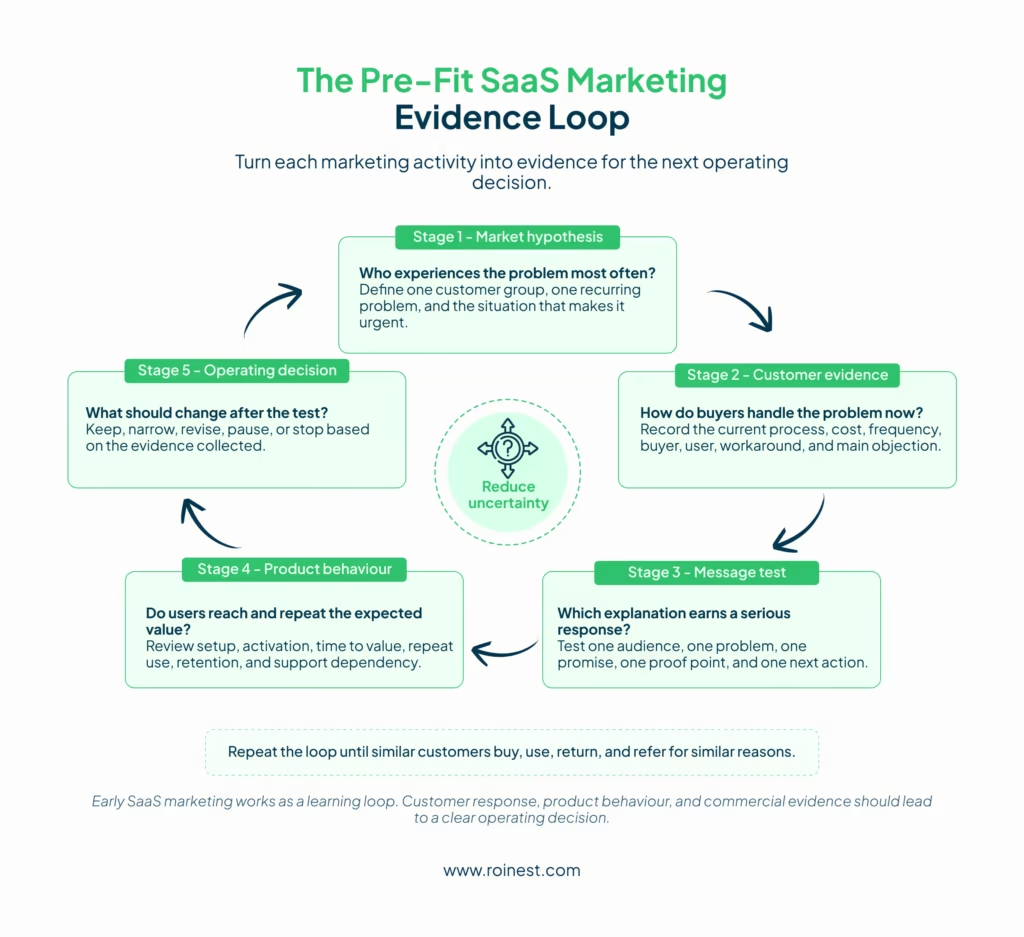
Before product-market fit, a SaaS marketing strategy has a narrower job. It should help the company identify a recurring problem, a defined buyer, a credible promise, and a workable route to adoption. Each campaign, sales conversation, onboarding session, and product interaction should reduce uncertainty.
A 2026 worldwide SaaS forecast projects revenue of US$488.53 billion. A growing category brings more buyers, more products, and more similar claims. Early companies need sharper evidence, not louder promotion.
Early marketing should help the company find a repeatable reason for customers to care, try, pay, stay, and tell someone else.
What Should a SaaS Marketing Strategy Achieve Before Product-Market Fit?
A pre-fit SaaS marketing strategy tests demand, customer fit, positioning, buying intent, adoption, and distribution before the company raises spending.
It is wider than a campaign calendar, which only says what will be published or launched. It is also different from a mature go-to-market plan because segmentation, pricing, sales motion, and distribution may still be moving.
Which uncertainties should be reduced first?
Begin with four questions.
Who experiences the problem frequently?
How costly or disruptive is it?
Who can approve a purchase?
Which product outcome can be observed within a reasonable period?
A buyer may agree that a process is inefficient and still postpone a purchase. A user may enjoy the product while the budget owner sees no financial reason to continue. Record interest, use, and buying intent separately.
The SaaS marketing strategy should produce evidence that changes a decision. A founder may publish a detailed problem explainer and receive responses from one type of company. A sales call may reveal that prospects already pay for a patchwork of tools. An onboarding session may show that users repeatedly reach one outcome while ignoring the broader product.
Traffic rarely provides enough context. A few detailed buyer conversations may reveal urgency, objections, budget ownership, alternatives, and implementation concerns that thousands of impressions cannot.
The output should be a clearer market, message, product decision, or reason to stop an unproductive activity.
Why Does Product-Market Fit Change the Marketing Plan?
Product-market fit appears through repeated customer behaviour.
A defined group experiences a recurring problem. The product solves it well enough for customers to buy, adopt, continue using it, and recommend it for similar reasons.
A 2025 product-market-fit guide places customer research, interviews, willingness to pay, use cases, price stability, and ongoing feedback among the evidence used to assess fit. These signals need to be read together. One popular launch, one large customer, or one unusually active account cannot prove a repeatable market.
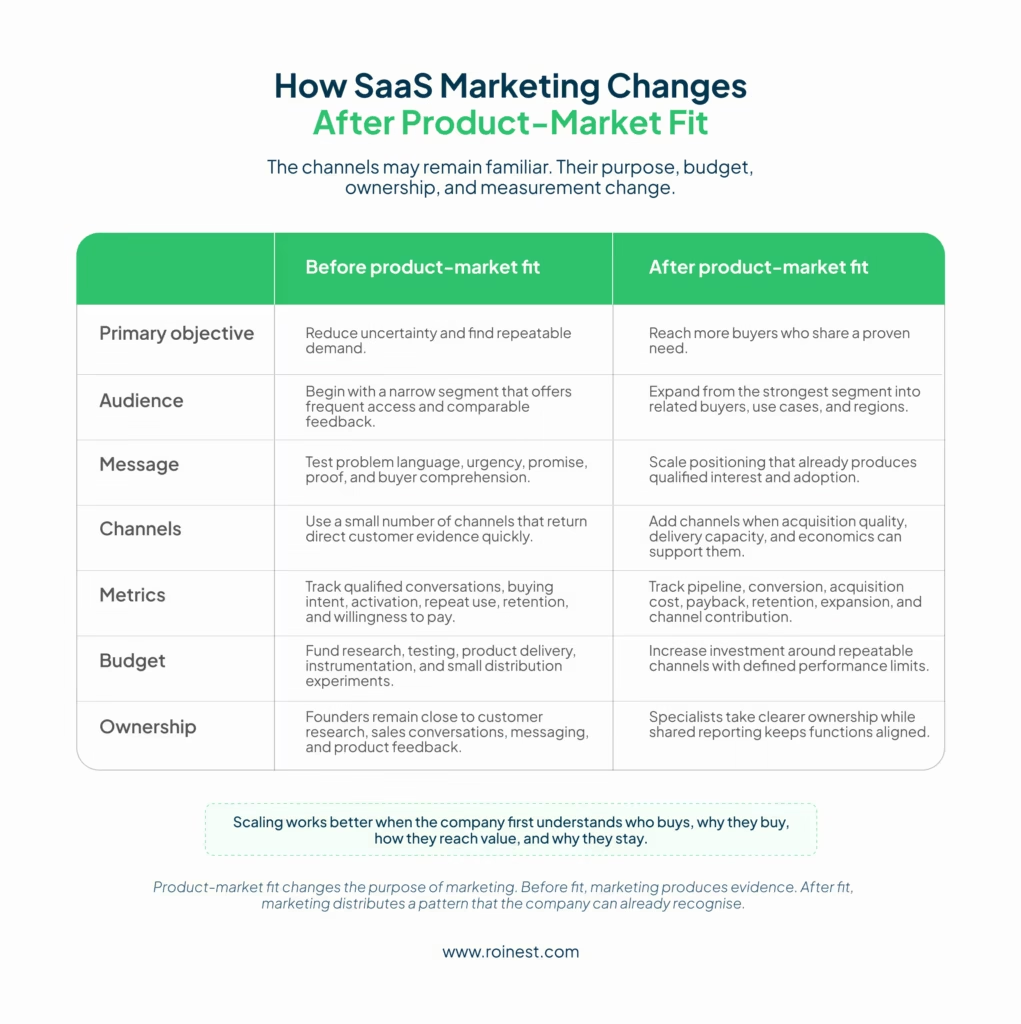
Before that pattern becomes visible, marketing behaves like an investigation. After the pattern strengthens, marketing can distribute what the company has learned.
How does marketing change after fit?
Early content tests problem language and buyer questions. Later content can build wider search coverage.
Early paid campaigns test audiences, messages, and offers. Later programmes can receive more funding when lead quality, retention, and pricing are better understood.
The SaaS marketing strategy should change as certainty grows. A channel built for learning should not be judged by scale targets.
Stronger fit changes sales conversations. Prospects begin asking about implementation, security, integrations, support, and commercial terms. Users complete the setup with less help. Customers return to the same workflow. Referrals arrive from people who understand the use case.
Revenue still needs context. A stronger pattern appears when comparable customers buy for comparable reasons through a process that can be repeated.
How Should Founders Choose the First SaaS Market?
A large total addressable market can support an investor discussion. It does not identify the first customer.
The first market should provide access to similar buyers, a frequent problem, a workable sales process, and enough commercial value for continued learning.
A narrow entry point makes the SaaS marketing strategy easier to test. That entry point may come from industry, company size, current technology, transaction volume, regulation, operating model, region, or a trigger event.
How narrow should the first customer profile be?
A usable ideal customer profile describes an operating condition, not a loose demographic category.
“Marketing leaders at growing ecommerce companies” remains broad.
A sharper profile could focus on Indian e-commerce companies spending across affiliate, influencer, and paid acquisition channels while struggling to connect partner payouts with verified revenue.
The second description guides account selection, content, demos, qualification, integrations, and product priorities. Repeated objections from similar buyers also produce a cleaner signal.
A narrow first profile does not define the company forever. It creates a stable place to learn. The SaaS marketing strategy can widen after the first segment begins showing repeated demand, adoption, and commercial value.
Should an India-based SaaS company begin locally or sell globally?
The answer depends on founder access, product category, contract value, regulation, implementation effort, buying behaviour, and available support.
India can offer faster customer access and closer observation. Global markets may offer higher contract values while bringing longer sales cycles, stricter security reviews, different data rules, extra integrations, and higher support expectations.
A 2025 overview of India’s SaaS sector reported more than one thousand SaaS companies as of 2023 and projected market revenue growth from US$7.18 billion in 2023 to US$62.93 billion by 2032. Projections are not guarantees, though they show the commercial depth being built around Indian software.
A company does not need a permanent identity as local or global. It needs a deliberate order. One region and one segment create a cleaner test than several countries, buyer groups, and pricing models launched together.
How Should Customer Research Shape the First Marketing Plan?
Customer research should sit inside the SaaS marketing strategy, not outside it as a one-time project.
The aim is to understand who notices the problem, what it costs, how it is handled, and what must happen before purchase approval.
Good research studies behaviour before opinion. A prospect may call a feature useful while spending no time or money on the problem.
Which customers should founders interview?
Include current users, lost prospects, inactive trial users, customers who adopted quickly, customers who needed heavy support, and companies still using an alternative process.
Avoid relying only on friendly contacts. Personal goodwill can produce polite approval and weak commercial evidence.
Keep the sample narrow enough for comparison. Comparable businesses reveal repeated language, triggers, objections, and buying roles more clearly than unrelated industries.
The SaaS marketing strategy should record company size, workflow volume, existing tools, authority, urgency, region, and implementation limits beside every interview.
What should a customer interview uncover?
Begin with the current process. Ask what happened the last time the problem appeared, who became involved, which tools were used, how long the work took, and what happened when it remained unresolved.
Then explore the purchase process.
Who owns the budget?
Which function signs off?
Does the purchase need security, legal, finance, or procurement approval?
What event would make the buyer act sooner?
What has already been tried?
What would make the company reject a new product?
Avoid turning the interview into a presentation. Once the product is explained in detail, the customer starts reacting to the pitch rather than describing normal behaviour.
How should evidence be recorded?
Use a shared record for product, sales, marketing, and customer success.
Capture the customer type, current process, problem frequency, business cost, existing alternative, trigger event, user, buyer, budget owner, main objection, implementation concern, and agreed next action.
Separate observation from interpretation.
“Three finance managers export data every Friday” is an observation.
“Finance departments need automation” is an interpretation.
The distinction reduces the chance that one memorable conversation becomes a broad market claim. The SaaS marketing strategy should move after repeated evidence, not after every comment.
How Should Positioning Develop Before Product-Market Fit?
Positioning helps a buyer understand who the product serves, which problem it addresses, what it replaces, and why its approach deserves attention.
Early positioning should be precise enough to test and flexible enough to change.
Many SaaS websites begin with AI, automation, dashboards, integrations, analytics, workflows, and one central platform. Buyers still need to connect the product with an urgent operating problem.
Which problem should lead the message?
Lead with the condition that the buyer already recognises.
An attribution platform may describe campaign analytics. A sharper message could focus on performance marketers who cannot compare partner quality after the first conversion.
A customer success product may describe AI-powered health scoring. A sharper message could focus on account managers who discover churn risk after renewal conversations have started.
The promise should describe a changed decision, process, cost, or outcome. Keep it close to what the product can already show.
The SaaS marketing strategy can test several expressions of the same problem. Avoid switching the market, buyer, offer, and channel in the same experiment.
What alternative is the customer replacing?
Every product competes with an existing behaviour.
The alternative may be another platform, a spreadsheet, an internal tool, an agency, a manual review, several point solutions, or the decision to do nothing.
A buyer compares the new product with the cost, risk, habit, and political comfort of the current process. Ask how the current method was chosen, what would break during a change, and which data would need to move. These answers shape copy, proof, onboarding, pricing, and sales preparation.
How can an early company show proof?
A young company may not have large case studies. It can still use a working product flow, a documented pilot result, a customer quote with context, an implementation walkthrough, usage data, a sample report, or a transparent explanation of the method.
Keep claims narrow. “Reduced weekly reconciliation work from six hours to ninety minutes during a four-week pilot” carries more information than “transformed finance operations.”
The SaaS marketing strategy should also address setup time, migration, security, internal approval, and training. Buyers may believe the outcome and still hesitate over adoption.
Which Channels Belong in a SaaS Marketing Strategy Before Product-Market Fit?
Use channels that reach the intended buyer and return useful feedback quickly.
Founder-led outreach, communities, referrals, partnerships, narrow search content, demonstrations, and small paid tests can all work. Their value depends on the market, price, sales cycle, and product setup.
When should founders use direct outreach?
Direct outreach works well when the first customer profile is narrow and likely accounts can be identified.
Begin with a recognisable problem, not a long product description. A short note can explain why the company is speaking with that buyer and invite a conversation around the current process.
Run controlled batches. Keep the segment stable while testing one message or offer at a time. The SaaS marketing strategy should connect outreach with a clear next step, such as an interview, demo, diagnostic review, or pilot discussion.
When can search content support early demand?
Search content can support early research when buyers already look for the problem, an alternative, an implementation method, or a product category.
Begin with a small group of pages around high-intent questions. Useful pages may explain a costly problem, compare current approaches, answer setup questions, describe a use case, show a product workflow, or help a buyer prepare for evaluation.
Follow official search guidance by using the language people search for in prominent locations, keeping links crawlable, and publishing helpful material created for readers. The exact keyword belongs in the title, introduction, relevant headings, and body when it fits the subject. Repetition should never replace useful coverage.
SEO before fit should be measured through qualified conversations, suitable sign-ups, assisted sales, and useful customer questions. Large traffic numbers can wait.
How can communities and partnerships help?
A focused industry community can provide customer access, language, peer comparison, and credibility.
Participate in the problem rather than arriving only to distribute links. A consultant, implementation firm, technology provider, association, or specialist publisher may already work with the intended customer. A joint workshop, integration, or customer guide can reveal stronger demand than a loose logo exchange.
The SaaS marketing strategy should record whether a partner produces introductions, product feedback, implementation support, trust, or distribution.
Should a pre-fit company run paid campaigns?
Paid media can test demand, but it can also create false confidence. A small campaign can compare problem statements, audiences, offers, and landing-page comprehension.
Look beyond click-through rate. Check whether suitable buyers responded, understood the offer, completed setup, reached value, and paid without an unusual discount.
Paid media becomes more useful when the SaaS marketing strategy already has a narrow audience, a clear message, a suitable next step, and enough delivery capacity to study the response.
When can product-led acquisition work?
A self-serve product can support learning when users can reach value without heavy integration, procurement, or training. Connect the promise with a visible result through sample data, guided setup, templates, or a focused workflow.
Complex B2B products may need a diagnostic, guided pilot, or implementation session instead of forced self-service.
What Content Should a SaaS Company Publish Before Product-Market Fit?
Early content should help the company learn, explain, and sell. A small library of detailed pages can support the SaaS marketing strategy while the market and message are changing.
Start with content close to a buying decision.
Prioritise problem explainers, use-case pages, implementation guides, comparison pages, and product walkthroughs. Each piece should show a clear reader, a clear question, and a clear next step.
How should AI support content production?
AI can speed up research organisation, transcripts, outlines, repurposing, reporting, and first drafts. It can also produce generic copy quickly.
A 2026 survey of more than 1,500 global marketers found that 86.4% use AI in at least some marketing activity, with content creation among the most common uses. The number shows broad adoption. It does not show that every AI-assisted page is useful or commercially effective.
Use AI for repetitive preparation while keeping customer evidence, examples, verification, operating judgement, and final editing with experienced people.
Official guidance on generative AI content says automation can help with research and structure, while large volumes of pages with little added value may violate scaled-content rules. Accuracy, quality, relevance, and useful context still apply.
How should content support AI search and answer engines?
Answer each heading directly. Define terms before expanding them. Keep examples close to the claim. Use descriptive headings, visible sources, accurate dates, useful links, and clear author information.
Official guidance for generative AI features in Google Search says normal SEO practices still apply. It recommends unique, expert-led, non-commodity content and says special AI files, forced content chunking, and rewrites aimed only at AI systems are unnecessary for Google Search.
AEO and LLM visibility do not need a separate writing personality. Clear structure helps people and search systems understand the same page.
The SaaS marketing strategy should combine original operating knowledge with straightforward explanations. A detailed process built from real customer work is more useful than a summary of existing articles.
How Should Marketing Work With Product, Sales, and Customer Success?
Early marketing cannot operate as a separate publishing function.
The promise made in an ad enters the sales conversation. Onboarding reveals whether expectations match the product. Usage and support requests show whether the value continues. All four functions need access to the same evidence.
What should sales return to marketing?
Capture the buyer’s problem language, trigger event, current alternative, decision process, budget owner, objections, implementation concerns, and reason for delay or loss. Marketing can use that evidence to revise pages, offers, proof, and channel selection.
The SaaS marketing strategy becomes more accurate when sales feedback is structured. Comments such as “the leads were weak” provide too little detail. A better review identifies which segment responded, which role attended, where the conversation stopped, and which concern appeared repeatedly.
Which product signals should change the message?
Compare the promised outcome with actual use.
If the campaign promises faster reporting, track whether users create and return to reports.
If it promises lower manual effort, observe whether the old workflow disappears.
If it promises better collaboration, review invitations, approvals, shared workspaces, or handoffs.
A gap between promise and behaviour may point to weak onboarding, the wrong customer, unclear value, or exaggerated copy. The SaaS marketing strategy should not keep acquiring users into a journey that repeatedly fails at the same point.
How should feedback be reviewed?
Hold one weekly review across interviews, outreach, sales notes, product usage, onboarding, support, pricing, and churn reasons.
End with a written decision. The company may keep one segment and test a new message, improve onboarding before sending more traffic, pause a weak channel, or ignore a one-off feature request.
A decision log prevents old tests from being repeated.
How Should Pricing & Packaging Support Market Learning?
Pricing is part of the SaaS marketing strategy because it tests value, buyer authority, procurement friction, and budget fit.
A customer may like the product and reject the price because the buyer lacks authority, the package includes too much, the financial outcome is unclear, or the problem has no active budget.
Test a pricing unit that customers understand, such as users, accounts, transactions, usage, data volume, or a fixed platform fee. Study how it connects with customer value and delivery cost. Avoid deep discounts that hide willingness to pay.
Set every pilot around a defined customer group, use case, duration, success measure, responsibilities, price, and decision date. The SaaS marketing strategy should treat a paid pilot as stronger evidence than verbal enthusiasm, while still comparing it with other accounts.
Which Metrics Show Useful Progress Before Product-Market Fit?
Pre-fit measurement should connect market response, product behaviour, and commercial response.
No single number proves fit across every SaaS model. Enterprise, self-serve, and usage-based products have different buying cycles and usage patterns.
Which market and product metrics are useful?
Track suitable accounts reached, qualified responses, interviews, demo progression, pilot acceptance, buyer urgency, and repeated objections.
A qualified response comes from the intended customer, describes the problem with some urgency, and agrees to a useful next step.
For the product, track setup completion, activation, time to first value, repeat use, main workflow frequency, data connections, support dependency, retention, and expansion requests.
Choose activation around a meaningful customer outcome. Logging in is rarely enough.
The SaaS marketing strategy should compare activation by segment and acquisition source. A channel that brings many sign-ups may still bring few customers who reach value.
Which commercial metrics are useful?
Track paid conversion, sales-cycle length, contract value, discount dependence, implementation cost, collection time, renewal intent, and referrals.
Customer acquisition cost can be misleading with a small sample. Use early unit economics as directional evidence and treat them as stable only after the company has enough comparable customers and a repeatable process.
Impressions, followers, traffic, downloads, and sign-ups are diagnostic numbers, not proof of demand.
The SaaS marketing strategy should connect every acquisition number with downstream behaviour.
How Should Early Marketing Experiments Be Designed?
An experiment should test one meaningful assumption and end with a decision.
Write the assumption before launch. Record the segment, message, channel, offer, sample, dates, cost, response, product outcome, commercial outcome, and decision. Change one major variable where possible.
If the company changes the audience, message, landing page, price, and sales process together, results may improve without showing which decision caused the change.
Some connected changes cannot be separated. A new segment may need a new message. Record the combined hypothesis clearly.
Small samples require caution. A result may show a direction without proving a rule.
The SaaS marketing strategy should maintain a decision log. The decision may be to continue, narrow, revise, pause, or stop.
How Should Founders Budget & Hire Before Product-Market Fit?
An early budget should support customer access, measurement, product delivery, and focused distribution tests. Do not begin with a universal percentage.
Fund customer access, product work, basic analytics, CRM records, interview capture, experiment tracking, and proof, such as a strong demo or pilot report. Delay broad media, large events, expensive brand campaigns, or an oversized software stack until the company knows what those investments will deliver.
A 2026 survey of 401 marketing leaders found that AI received an average of 15.3% of marketing budgets, while only 30% reported mature or fully developed readiness. Most respondents represented companies with more than US$1 billion in annual revenue, so the figures should not be copied into an early SaaS budget. They still show how spending can move ahead of operating readiness.
When should the first marketing hire join?
A first marketing hire becomes useful when the role has a defined purpose. That person may own research, positioning, content, sales support, analytics, and small experiments.
The founder should remain close to customer conversations, message decisions, pricing, and product evidence. Hiring should increase the quality and speed of learning. One person cannot run every marketing function at full depth.
Why Does Execution Support Affect The Outcome?
Capital can fund hiring, product work, software, advertising, research, and expansion. It cannot decide which assumption deserves attention or connect feedback across functions.
Execution turns information into changed behaviour.
Product, sales, customer success, and marketing operators can turn customer evidence into product choices, qualification, onboarding, positioning, content, and experiments.
The SaaS marketing strategy improves when these people work from the same evidence.
How do builder and operator networks help?
A builder network gives founders access to people who have handled similar stages, functions, and markets.
The value comes from applied work. An operator may review calls, rewrite onboarding, prepare a pilot, test pricing, or open a relevant customer conversation.
Co-founder networks can fill capability gaps. Fit depends on working style, ownership, time, and decision authority.
Shared infrastructure can cover legal templates, finance processes, recruitment, analytics, CRM structure, design systems, cloud guidance, security preparation, research methods, sales material, and launch operations.
Warm access to suitable buyers, partners, operators, and regional networks can shorten the distance between an assumption and a useful conversation.
A founder-led startup studio such as ROINest sits closer to this execution model than a passive capital network. Its work spans product, technology, sales, customer success, marketing, infrastructure, and market access through direct participation and clear ownership.
What’s Next?
Begin with one customer segment, one recurring problem, one clear promise, and a few channels that return useful evidence.
Create a record covering the current process, problem frequency, business cost, trigger event, user, buyer, budget owner, alternative, objection, and next action.
Build the first SaaS marketing strategy around a small evidence loop.
Run customer conversations. Test one message. Observe product use. Review pricing and buying behaviour. Make a written decision. Then repeat the process with comparable customers.
Keep marketing, product, sales, customer success, and delivery connected through one weekly evidence review. Pause acquisition when onboarding repeatedly fails. Revise the promise when users reach a different value from the one being promoted. Narrow the market when feedback becomes too varied to compare.
Capital can increase the pace of activity. Proven operators, builder networks, functional support, shared infrastructure, and market access help convert that activity into company progress.
A SaaS marketing strategy before product-market fit should leave the business with fewer assumptions and better decisions. Similar customers should begin buying, using, returning, and referring for similar reasons before wider distribution receives larger budgets.
That gives the company a more stable base for growth.
Follow us on LinkedIn for weekly updates and bite-sized informational content.
Frequently Asked Questions
1. How much should a SaaS company spend on marketing before product-market fit?
There is no reliable percentage that applies to every early SaaS company. A pre-fit budget should be built around specific questions the company needs to answer. Money may be used for customer research, prototypes, analytics, small message tests, focused events, direct outreach, or limited paid campaigns.
Each expense should have a learning objective and a decision attached to it. Increase spending only when the SaaS marketing strategy begins producing comparable customer responses, meaningful product use, and clearer buying intent.
2. Should a SaaS founder hire a marketer before product-market fit?
A marketing hire can help when the founder has enough customer access and product evidence to give the role a clear operating purpose. The first hire often needs to work across research, positioning, content, sales support, analytics, and experiments rather than manage one narrow channel. The founder should remain involved in interviews, sales conversations, and message decisions.
Hiring someone to create distance between the founder and the customer usually weakens early learning. Hire when the role can improve the feedback process, not merely increase output.
3. Can SEO support a SaaS marketing strategy before product-market fit?
Yes, though the scope should remain controlled. Early SEO can help founders study search language, answer high-intent questions, test use cases, and attract buyers already researching the problem. Start with a small number of useful pages around customer problems, implementation questions, alternatives, comparisons, and buying concerns.
Avoid building a large publishing programme while the target customer and positioning are still changing. Judge early SEO through qualified conversations, product sign-ups, and customer learning rather than traffic alone.
4. What should a founder do when users like the SaaS product but refuse to pay?
Separate product appreciation from commercial demand. Review who receives the benefit, who controls the budget, how often the problem occurs, what happens when it remains unresolved, and which alternative the customer already funds. Test whether the issue comes from pricing, packaging, procurement, weak urgency, unclear financial value, or a mismatch between the user and buyer.
A smaller pilot, paid design partnership, restricted package, or different customer segment may reveal whether the product has value that can support a repeatable business.
5. How can an India-based SaaS company test international demand without expanding too early?
Choose one region and one customer segment rather than treating international growth as a single test. Interview local buyers, review their buying process, identify required integrations, understand payment and data requirements, and test whether the problem carries enough urgency. Use founder networks, industry partners, focused communities, and a small number of target accounts.
Compare sales-cycle length, implementation effort, support expectations, and willingness to pay with the Indian market. Broader expansion can follow after the company finds a repeatable pattern.
6. How often should a pre-fit SaaS marketing strategy be reviewed?
Review evidence weekly and revise the wider strategy at defined intervals, such as every four to six weeks. Weekly reviews should cover customer conversations, campaign responses, objections, activation, usage, retention, and commercial progress.
The wider review should decide whether the customer segment, problem, message, offer, channel, or product experience needs adjustment. Avoid changing the full strategy after every conversation. Repeated evidence from comparable customer accounts carries more weight than one enthusiastic lead, one lost deal, or one unusually active user.