
Most first-time founders enter fundraising with one clear belief. Once the money comes in, the company will finally have room to move.
They spend months chasing investors, polishing decks, and waiting for a yes. Then the round closes, and a different kind of pressure begins.
Capital helps, of course. It gives you room to build, hire, test, sell, and survive a few wrong turns. But just money rarely fixes wobbly execution. As a founder, you still need product clarity, customer proof, a working go-to-market plan, and people who can act fast when things go south.
For startups, early stage startup funding works best when it meets real operating discipline. The raise should support momentum that already exists, even if it is still small.
What Counts as Early Stage Startup Funding?
Early stage startup funding usually covers the capital raised before a company reaches predictable scale. This can include pre-seed funding, seed funding, angel capital, incubator support, grants, and early venture capital.
At this point, the company may still be shaping the product. Revenue may be early. The sales motion may still be manual. The team is often small, and the founder is still close to every decision.
The Startup India funding guide describes funding as money used to start and run a business, including product development, hiring, working capital, sales, marketing, office costs, and operating needs. It also notes that founders should be clear about why they are raising before they approach investors.
India’s startup base also shows how much wider the early-stage market has become. By March 31, 2026, India had crossed 2.23 lakh DPIIT-recognised startups, with more than 23.36 lakh direct jobs created.
Many first-time founders raise because they are running out of money. Investors prefer founders who can explain the next build, proof, or market push the capital will support.
How Does Early Stage Startup Funding Differ From Growth-Stage Funding?
Early stage startup funding is built around potential, proof, and the founder’s ability.
Growth-stage funding is built around scale.
At the early stage startup funding, investors still don’t have a clear answer to some questions, like, ‘Does the problem really exist?’, ‘Is the founder close enough to the market?’, ‘Can the product become useful enough for customers to pay?’, ‘Can the team build and sell at the same time?’, etc.
Whereas investors, who are at the growth stage, want to see stronger revenue history, repeatable customer acquisition, mature teams, better reporting, and clear expansion paths.
India’s FY26 numbers show how investors are becoming more selective across stages. Indian startups raised $11.7 billion in FY26, down 18% from FY25, while early-stage funding rose to $4.8 billion, up 33% from the previous year. Seed-stage funding fell 15% to $1.3 billion, while late-stage funding dropped 38% to $5.6 billion. So, the market is more careful.
Indian startup funding in Q1 2026 showed the same pattern in a sharper light. Indian startups raised $2.3 billion during the quarter, down 26% year-on-year, while seed-stage startups raised $248 million, up 58% year-on-year.
How Do Pre-Seed, Seed, Angel, Incubator, and VC Funding Work?
Every funding path has a different job; let’s take a look at them in detail:
– Pre-Seed Funding
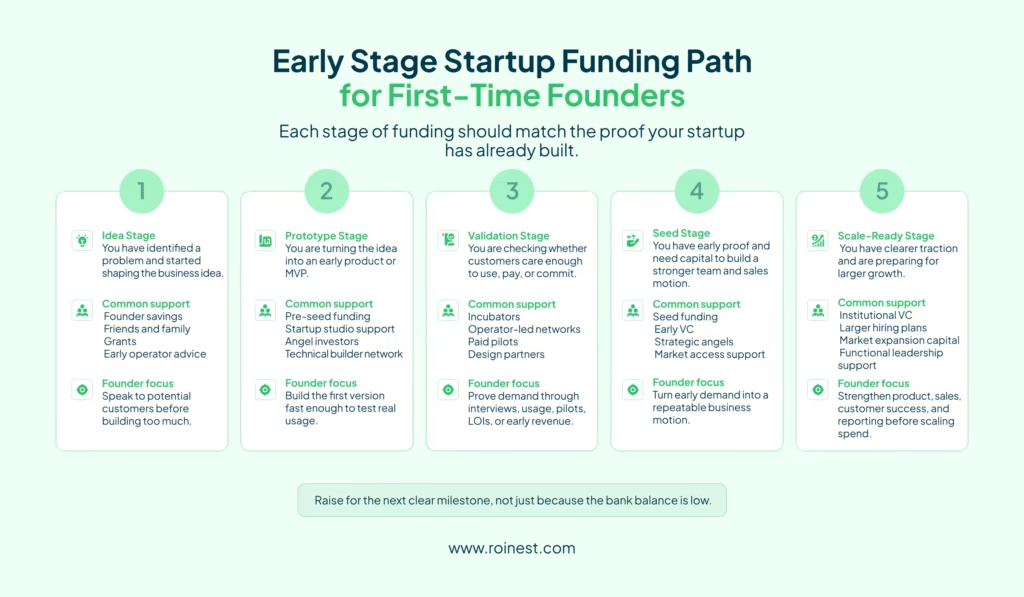
Pre-seed funding usually helps founders move from idea to early product. The money may come from personal savings, friends, family, angels, startup studios, grants, or early believers.
Carta’s Q1 2026 data shows ~3,000 U.S.-based startups on its platform raised more than $2.3 billion in pre-seed capital, with the total expected to reach around $2.9 billion as more data comes in.
Pre-seed is often used for product discovery, MVP development, early hiring, customer interviews, pilots, and first market tests.
– Seed Funding
Seed funding usually comes after stronger validation. The product is live, there are paying customers, pilot users, a pipeline, or a strong waiting list.
In B2B SaaS, seed investors often want signs of repeat usage, customer pull, and revenue quality. Even if the numbers are small, they need to show direction. Seed funding helps build the core team, improve the product, invest in sales and marketing, and test repeatable growth.
– Angel Funding
Angel investors usually invest personal capital and may back a founder because they believe in the person, the sector, the early signs, or the network around the startup.
Good angel investors can bring introductions, hiring support, customer access, and sharper thinking. Passive angels can still be useful, but they don’t change the operating path.
– Incubator & Startup Studio Support
Incubators often offer mentorship, office space, structured programs, and access to networks.
A founder-led startup studio works closer to the build itself. For ROINest, the studio idea is tied to operators, builders, co-founder networks, shared infrastructure, and functional support across tech, product, customer success, sales, and marketing.
Early teams struggle when product, hiring, sales, customer feedback, and execution all hit at the same time.
– Venture Capital
VC funding is suited to businesses that can grow large, fast, and across markets.
This path fits some startups well. It does not fit every startup. A profitable niche SaaS company may not need venture capital. A capital-heavy AI infrastructure business may need it much earlier. The funding type should match the business model. Forcing a VC path on the wrong company creates pressure that the business may not be built to carry.
What Do Investors Expect From Early-Stage Founders Today?
Investors expect a founder to know the business better than anyone else in the room.
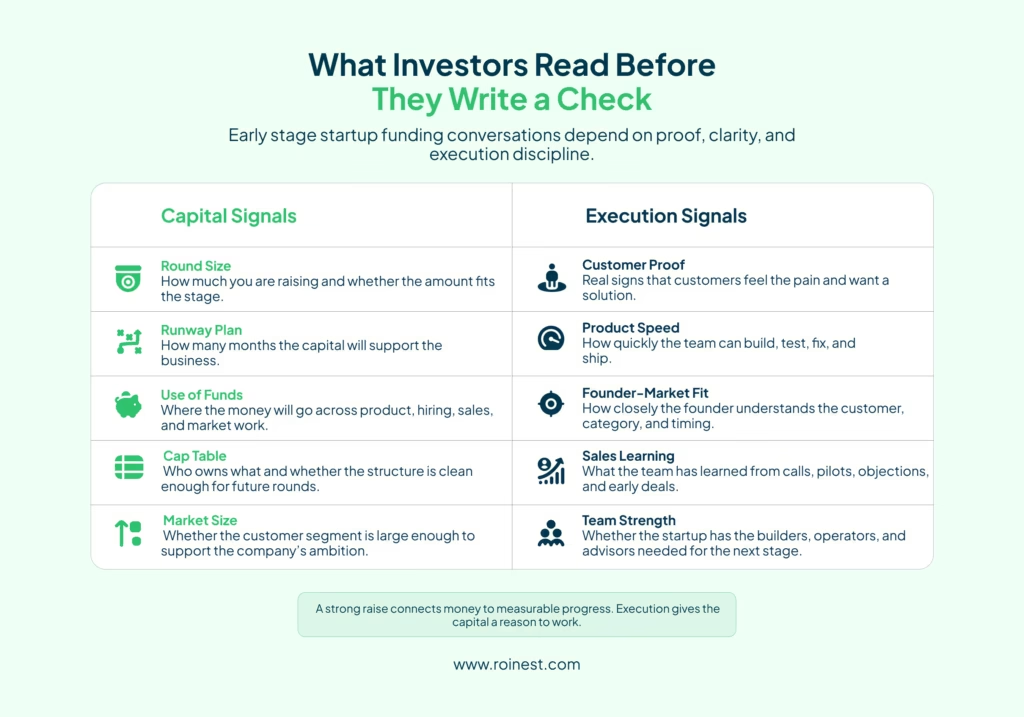
A strong founder explains the customer, the pain, the current workaround, the buying trigger, the budget owner, the product gap, the sales cycle, and the next 12 months of work.
Early stage startup funding usually tests five key areas:
1. Show problem clarity:
A founder should be able to explain who has the problem, how often it appears, how painful it is, and why existing options are not enough. In B2B, vague pain does not sell. Specific pain does.
2. Show proof of effort:
Investors can tell when a founder has spoken to customers. The language is changed, they have a more grounded pitch, their choices related to their product are clearly motivated by customer data.
3. Show execution speed:
Early startups are mostly slow at planning. They ship, learn, fix, sell. Investors, in such situations, often tend to look for signs that show that the team can keep acting without waiting for perfect conditions to magically appear.
4. Show capital discipline:
A raise should have a use case, for example, hiring five people because the money is available is not a plan, but hiring one strong product engineer to reduce delivery delays might be.
5. Show founder honesty:
No early startup has everything figured out and investors know this, they do not need a perfect plan. They need a founder who knows the gaps and has a working plan to close them.
In the U.S., AI is pulling a large share of the earliest-stage capital. AI startups received about 50% of pre-seed dollars in Q1 2026, up from roughly 30% a few years ago. The same data also shows mid-sized pre-seed rounds between $1 million and $2.5 million fell from 24% of rounds in Q1 2023 to 18% in Q1 2026.
The global funding picture also explains why investors are asking for stronger proof. In Q1 2026, AI companies received $242 billion, equal to 80% of total global venture funding.
Founders in AI, SaaS, adtech, and B2B tech should read that carefully. Capital is available, but it is clustering around teams that can move with speed and proof.
Why Does Validation Matter Before Raising Capital?
Validation is not to remove the risk, but to make the investor conversation more grounded.
The U.S. market shows how misleading headline numbers can be. Q1 2026 U.S. VC deal value reached $267.2 billion, but excluding the five largest deals and exits brings deal value down by 73.2% and exit value down by 86.6%.
A founder with validation can say, “Here is who we spoke to, here is what they tried before, here is what they paid for, and here is why they stayed or why they did not.”
Validation can be small and doesn’t always need hundreds of customers. Founders can validate through customer interviews, paid pilots, repeat usage, signed LOIs, strong retention from a small user base, workflow adoption, or clear demand from a narrow customer segment.
Revenue helps, of course, but even before that behavior matters because if users keep returning, ask for more features, invite their team, request pricing, or compare you with existing tools, you are much more likely to get funded.
What Should Founders Prepare Before Their First Investor Conversation?
1. Build the funding story-
Explain why you are raising and work on what stage of work you can show to convince investors.
For example, a B2B SaaS founder may raise to complete the product, convert pilots into paid customers, hire one sales lead, and build a repeatable outbound motion in India and the U.S.
2. Prepare clear numbers-
Even early founders need basic numbers. Track burn, runway, revenue, pipeline, customer acquisition cost where possible, churn signals, product usage, sales cycle length, and gross margin assumptions.
3. Know the use of funds-
Break the raise into different areas of use like product, hiring, sales, marketing, compliance, cloud costs, market entry, and customer success, all of which need different thinking.
4. Build the first investor list with intent-
Do not pitch every investor in the market. Find investors, angels, studios, or operator networks that understand your category.
For SaaS, B2B, AI, and adtech startups a consumer investor may not understand a six-month enterprise sales cycle, and a deeptech investor may not care about a lightweight martech workflow.
5. Clean up the basics-
Unclear founder agreements, poor data rooms, weak compliance hygiene, all of these can all slow the process.
Equity, debt, and grants are different funding types, each with different repayment, ownership, and involvement models. Founders should understand these options before they give up equity too early.
Do You Know If You Are Too Early to Raise?
Sometimes, for a founder, it can be too early to raise from the wrong capital source.
On one hand, you may be too early for VC if the product is still only an idea, no customer has validated the pain, the team lacks build capacity, or the market is unclear. On the other hand, you may still be ready for a grant, studio program, angel check, or a structured founder network.
Early stage startup funding should match the risk profile. If the biggest risk is product creation, pre-seed funding, or studio support may fit, but if the biggest risk is selling to a first customer group, angel money or operator support may help.
A simple self-check helps.
- Can you explain the customer without using broad market labels?
- Can you show some proof that the problem exists?
- Can you build the first version without hiring a full company?
- Can you explain exactly how the next capital will change the business?
- Can you accept feedback without losing the core idea?
If the answer to most questions in the above checklist is no, your business may need more building before fundraising.
Want bite-sized updates and more informational content weekly? Follow us on LinkedIn now!
Frequently Asked Questions
1. How much early stage startup funding should a founder raise first?
A founder should raise enough early stage startup funding to reach the next clear milestone, not the largest amount the market will allow. For a SaaS or B2B startup, that milestone may be an MVP, five paid pilots, first revenue, a working sales motion, or a stronger product team. A smaller focused round can be healthier than a large round with unclear spending. The amount should connect to runway, hiring needs, product build, and customer acquisition work.
2. Is pre-seed funding better than seed funding for first-time founders?
Pre-seed funding is usually better when the founder is still proving the product, customer pain, and first use case. Seed funding fits better when there is stronger validation, early revenue, active pilots, or signs of repeat demand. First-time founders should not rush into seed funding only for the label. The right stage depends on proof. If the company still needs heavy discovery, pre-seed funding or startup studio support can create a better base.
3. How can founders get funding for startup ideas without revenue?
Founders can get funding for startup ideas without revenue, but they need proof in other forms. Customer interviews, pilot commitments, prototype usage, waitlists from relevant buyers, signed LOIs, founder-market fit, or strong technical depth can all help. In India, founders can also explore grants, incubator programs, Startup India support, angel networks, and early-stage funding India programs. Revenue is useful, but serious customer evidence can still open doors.
4. Is startup funding India different from funding in the U.S. or EU?
Startup funding India has become deeper, but investor behavior can differ by market. Indian investors often look closely at revenue discipline, practical market size, capital use, and founder execution. U.S. investors may accept larger early bets in categories like AI, but they still expect speed and strong proof. EU investors may focus more on compliance, cross-border readiness, and sustainable growth. The core rule stays the same, and that is ‘early stage startup funding follows proof’.