
Startup funding India usually gets talked about as if it begins with investors.
For most first-time founders, it begins with a rough problem statement, a few customer discussions, and a basic question: Is this actually worth funding?
India had crossed 2.23 lakh DPIIT-recognised startups as of 31 March 2026, and more than 55,200 startups were recognised in FY 2025-26 alone. The ecosystem is clearly still growing, but it is also getting more crowded, which means investors can be more selective than before.
At the same time, the funding environment has just become more careful. According to Q1 2026 reports, Indian startups raised $2.3 billion in the quarter, down 26% year-on-year, while seed-stage funding rose 58% year-on-year.
A founder once walked into a funding discussion with a well put-together deck and a lot of confidence. But there was an issue, the startup had simply spoken to too few customers to know whether the pain point was real. The early work, like customer conversations, small tests, and a few hard decisions, is less popular and exciting than fundraising itself.
The Importance of Startup Funding India For New Founders
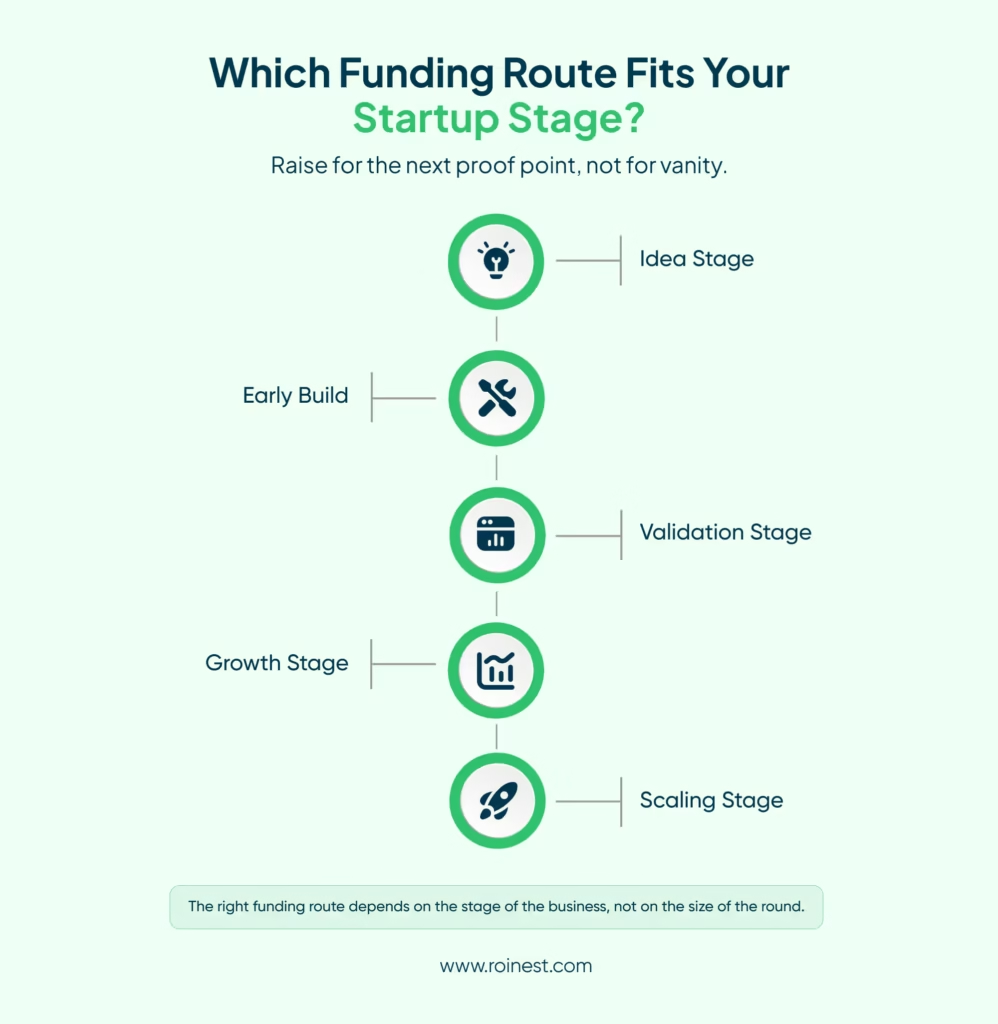
For a first-time founder, startup funding India is really about stage fit, and that includes things like pre-existing proofs, what to build with the next round of funds, etc. Since different stages need different kinds of support, this distinction is important to understand.
At the idea stage, money usually goes toward validation, customer discovery, research, and maybe a very basic prototype. At the MVP stage, startup funding India starts supporting product improvement, early sales, and small experiments that show whether people will actually use the product. At the seed stage, the money is supposed to help the business grow in a more repeatable way, not just survive another few months.
There is also more support available now than many founders realise. The Startup India Seed Fund Scheme supports proof of concept, prototype development, product trials, market entry, and commercialisation, while the government’s Fund of Funds 2.0 adds another layer of capital support for innovation-led startups.
But what is this money supposed to prove?
Why Funding is Not The First Step & What Do Investors Actually Fund?
A lot of first-time founders rush toward startup funding before the business has enough shape to deserve outside capital.
That is actually because, usually, startup funding India is seen as progress. It feels like momentum and gives a startup credibility in front of others. But funding without clarity of outcome can create pressure rather than progress.
Founders ask for money before they have enough certainty about what that money is supposed to do.
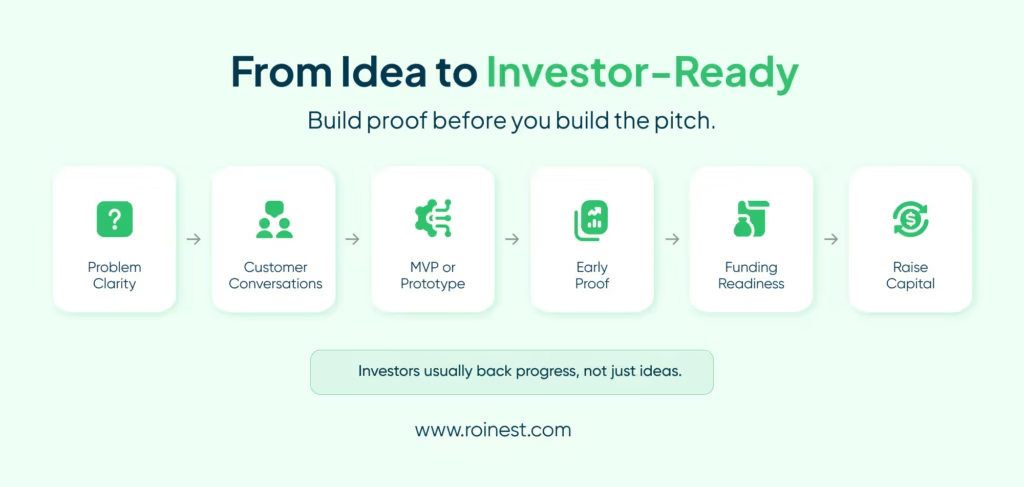
Now, investors may not expect perfection, but they do expect direction and may want to know who the customer is, why the problem matters, and what has already been learned from the market.
Sometimes the business is not ready for outside capital yet and needs more customer learning, a prototype, or a pilot before funding adds real value.
Investors do not fund enthusiasm.
They fund a blend of founder quality, market size, timing, product thinking, early proof, and execution ability. That is especially true in startup funding India because the number of recognised startups has been rising quickly and competition for capital is now much tougher than it was ever before.
For a B2B SaaS, AI, adtech, or tech-led startup, investors usually want to see whether the problem is frequent enough, painful enough, or expensive enough to solve. They also want to know whether the product can become repeatable, whether the buyer is obvious, and whether the founder can both build and sell without losing the thread.
The Main Startup Funding India Options Available to New Founders
Funding has changed quite a bit over the last few years. Founders are no longer expected to follow one fixed path where they bootstrap for a while, raise an angel round, and then move into seed funding. Some startups spend years growing through customer revenue, some work with incubators before meeting investors, and some may never raise outside capital at all.
1. Bootstrapping
Most founders do not think of it as a startup funding India strategy, yet most startups begin here.
Bootstrapping means building with personal savings, early revenue, or money generated by the business itself. It has slow growth, but it forces founders to stay connected to customers and spend the budget carefully.
2. Government Grants and Startup Schemes
Research-led businesses, deeptech startups, and early-stage products often need validation before they need investors, and government-backed initiatives like the Startup India Seed Fund Scheme have helped support proof of concept, prototype development, product trials, market entry, and commercialisation for multiple startups.
It is a fact that grants take some time to come through and there is a lot of paperwork involved but they can reduce the need to dilute ownership too early.
3. Angel Funding
Angel funding is when many founders first meet outside investors.
The right angel investor often brings industry experience, introductions, hiring advice, and early customer connections that can be just as valuable as capital. Most angels still expect founders to have a clear understanding of the problem, the customer, and what the funding is meant to achieve.
4. Pre-Seed Funding
Pre-seed funding usually comes when the business is still proving that the market exists.
The money often goes towards building the first version of the product, improving the MVP, hiring a small team, or testing early customer acquisition.
At this stage, investors are usually backing potential and progress rather than scale.
5. Seed Funding
Seed funding is often the point where a startup begins preparing for repeatable growth.
Depending on the sector, that proof may come through paying customers, successful pilots, partnerships, product usage, or early revenue. While overall startup funding slowed in the first quarter of 2026, early-stage investment remained comparatively resilient, showing that investors continue to back startups with clear early signals.
What Do Investors Actually Look For?
This is probably one of the most common questions around startup funding India, and it usually gets answered with a checklist.
- Strong team.
- Large market.
- Scalable business model.
- Clear vision.
Those things are considerable, but they make the process seem more mathematical than it really is.
A lot of investment decisions come down to whether the business is solving a problem that people genuinely care about. The product does not have to be perfect. In fact, most early-stage products are not. But there should be some evidence that the founder understands the customer and is moving in the right direction.
That proof can be a waiting list, paying customers, an expanding pilot, or strong early engagement.
A founder saying there is a huge market is one thing. A founder showing that customers are already spending time or money on the solution is something else entirely.
Additionally, execution matters too.
The Indian startup ecosystem has matured, and investors have seen enough cycles to know that ideas alone are not particularly rare. The ability to build, adapt, and keep moving when things do not go according to plan is often what separates promising startups from the rest.
This is especially true in sectors like SaaS, AI, adtech, fintech, and enterprise technology, where products can change quickly and customer expectations move just as fast.
Another factor that does not get enough attention is capital efficiency.
A few years ago, founders could sometimes raise money on the promise of growth alone. The market looks different today. Investors still want growth, but they also want to understand how the business is using capital and what the next milestone looks like.
Common Mistakes First-Time Founders Make While Raising Funds
Mistakes are part of the process. The problem is making easily avoidable mistakes.
One of the most common ones is trying to raise too much money too early.
On paper, a larger round sounds attractive. In practice, it can increase expectations before the business is ready. The startup suddenly has more pressure to hire, spend, and grow at a pace that may not match the market.
The opposite also happens.
Some founders wait for perfect conditions that never arrive. They keep improving the product, adding features, and delaying conversations because they believe one more milestone will make all the difference.
It usually does not work that way.
Fundraising is rarely about reaching a perfect state. It is about demonstrating progress and showing that the business knows what comes next.
Another mistake is treating the pitch deck as the main product.
A good deck helps organise the story, but investors are usually trying to understand the business and related information such as:
- Who is the customer?
- Why does the problem matter?
- What has the team learned so far?
- Why is this the right time for this startup to exist?
Those questions tend to linger around even when the presentation is over.
There is also a tendency to assume that every investor is the right investor. That can create problems later. A founder building enterprise software may need a very different kind of investor than someone building a consumer marketplace. Industry understanding, network, experience, and expectations all play a role.
How Can Founders Prepare Before Looking for Startup Funding India?
Investors know early-stage businesses change direction, that forecasts will be wrong, and that products evolve.
What they really want to look at is whether the founder has done actual groundwork, like understanding the customer.
Talking to customers may sound easy enough, yet it is one of the most useful things an early-stage startup can do. It can help reveal gaps that the internal team might have missed out on. They help founders understand whether the problem is painful enough for someone to actually pay to solve it.
The next step is clarity around the product.
The business does not need dozens of features, nor a perfect roadmap. It should just have a clear explanation of what it does and who it is built for.
Founders should also understand their numbers. Basic metrics like customer acquisition cost, retention, conversion, average revenue, burn rate, and runway may be different for every startup but having a grip on them is crucial.
Finally, there should be a realistic plan for how the funding will be used. Investors are not only evaluating the current situation, but they are also trying to understand what the startup could look like twelve or eighteen months after the round closes, at the same time.
The Future of Startup Funding India
The Indian startup ecosystem is still evolving. New sectors are attracting investor attention. AI, deeptech, climate technology, enterprise software, and advanced manufacturing are all creating opportunities that looked very different a decade ago.
Government-backed initiatives are also expanding.
The recently announced ₹10,000 crore Fund of Funds 2.0 is expected to strengthen support for innovation-driven sectors and help improve access to growth capital across the ecosystem.
At the same time, founders are becoming more practical.
Growth is still important, but sustainable growth is becoming a bigger part of the conversation. Capital efficiency, product-market fit, and revenue quality are no longer topics reserved for later funding rounds.
That evolution is probably healthy for the ecosystem. The startups that succeed over the next few years are unlikely to be the ones that simply raise the most money. More likely, they will be the businesses that understand their customers, build carefully, and use capital to accelerate something that is already working.
Final Thoughts
Startup funding India is often presented as a journey that begins with investors, whereas most of the time, it begins with customers.
Funding is important; there is no point pretending otherwise. Building a product, hiring a team, and entering new markets all require resources and no one is denying that, but outside capital works best when the business already has some direction.
Founders do not need every answer before approaching investors. What they do need is a clear understanding of the problem they are solving, the people they are solving it for, and the progress they expect funding to create.
The ecosystem has become larger, more competitive, and more sophisticated. That can make fundraising feel difficult, especially for first-time founders.
It also creates opportunities. There are more incubators, more government-backed initiatives, more angel networks, and more specialised investors than before. The challenge is not simply finding capital.
It is finding the right kind of capital at the right stage of the business.
The startups that approach funding with that mindset are usually in a stronger position, whether they decide to bootstrap for longer, apply for grants, raise an angel round, or prepare for institutional investment.
Want to know more, or just stay updated? Follow us on LinkedIn for more!
Frequently Asked Questions
1. What is startup funding India?
Startup funding India refers to the different ways founders raise capital to build and grow a business. Depending on the stage of the startup, this can include bootstrapping, government grants, incubator support, angel investment, pre-seed funding, seed funding, venture capital, or other forms of financing.
2. Is bootstrapping better than raising investment?
Neither option is automatically better. Bootstrapping gives founders more control and encourages careful spending, while outside investment can help a business grow faster. The right approach usually depends on the product, the market opportunity, and the resources needed to build the business.
3. What do angel investors usually look for?
Angel investors generally look for founders who understand their market, have a clear product direction, and can demonstrate early signs of demand. They may also consider the size of the opportunity, the team’s ability to execute, and the startup’s plans for using the funding.
4. What is the difference between pre-seed and seed funding?
Pre-seed funding is usually raised when the business is still validating the product and the market. Seed funding often comes later, when the startup has stronger proof of demand and is preparing to scale operations, customer acquisition, or team growth.
5. Can a startup grow without external funding?
Yes. Many businesses grow through bootstrapping and customer revenue, especially during the early stages. External funding can accelerate growth, but it is not the only path available to founders.